by Jessica Anne Pressler, LCSW
Maybe you are still in a relationship with a narcissistic partner and quietly wondering whether you can get out. Maybe you have just walked away. Or maybe you were the one who was discarded suddenly by someone who once swore you were everything to them. The confusion, the longing, the exhaustion, the moments when you would give almost anything to hear their voice again even though you know how it ends. None of this means you are weak or unwise. It means you were in a relationship designed, consciously or not, to keep you attached. And it means you are human.
What It's Like to Be in a Narcissistic Relationship
Narcissistic relationships tend to follow a recognizable cycle. It rarely looks dangerous at the start. In fact, it usually looks and feels like the best thing that has ever happened to you.
The Trauma Bond:
Idealization. In the beginning, you are adored. There is intense attention, constant contact, grand gestures, and a sense of being truly seen. They may tell you they have never felt this way before, that you are soulmates, that you understand them like no one else. This phase is often called love bombing, and it creates a powerful emotional and chemical bond very quickly.
Devaluation. Slowly, and often so gradually you can't name when it began, the warmth starts to cool. Criticism creeps in, sometimes disguised as jokes or "just being honest." You find yourself apologizing for things you didn't do. Your perceptions are questioned: that didn't happen, you're too sensitive, you're remembering it wrong. This is gaslighting, and over time it erodes your trust in your own mind. Your feelings become inconvenient. Your successes may be minimized or competed with. Your boundaries are tested and then punished. You learn to walk on eggshells, managing their moods so carefully that you slowly lose track of your own.
Intermittent reinforcement. Just when you are ready to give up, the person you fell in love with comes back. A tender moment, a heartfelt apology, a glimpse of the old warmth. Then it disappears again. This unpredictable pattern of reward and punishment is one of the most powerful bonding mechanisms there is. It keeps you hoping, waiting, and working harder for the good moments.
Discard, or the threat of it. At some point you may be pushed away, ignored, given the silent treatment, or replaced, sometimes followed by a return that starts the cycle all over again.
How Deeply Invested You Were
People on the outside sometimes ask, "Why didn't you just leave?" What they can't see is how much you poured into this relationship. You gave your time, your energy, your trust, your hope, and often your sense of who you are. You may have built a home, a family, finances, friendships, and a future around this person. You may have rearranged your life again and again to keep the peace.
Many of the people who end up in these relationships are deeply empathic, loyal, and committed. They believe in repair. They believe that if they love well enough, explain clearly enough, or try hard enough, things will get better. These are beautiful qualities. In a narcissistic relationship, unfortunately, they are exactly the qualities that get exploited.
So when you walk away, you are not just leaving a person. You are leaving the dream of who you hoped they were, the future you imagined together, and a version of yourself that kept trying. That is an enormous loss, and it deserves to be grieved.
The Somatic Piece: What Is Happening in Your Body
Your nervous system has been living in survival mode. When you live with unpredictability, criticism, and the constant possibility of conflict, or abandonment, your body stays on high alert. Your stress response system keeps firing, releasing stress hormones like cortisol and adrenaline. Over months or years, this can show up as tight shoulders and jaw, headaches, digestive trouble, poor sleep, racing thoughts, a constant sense of dread, poor immune system and exhaustion.
Your body learned that safety meant pleasing them. Many people in these relationships develop a fawn response, an automatic urge to appease, soothe, and accommodate in order to stay safe. Others swing between fight, flight, and freeze. These responses are not character flaws. They are your nervous system doing its best to protect you.
Your brain chemistry got wrapped up in the cycle. The highs of reconnection after conflict can bring a flood of feel-good chemistry related to reward and bonding. Have you ever heard of someone saying how amazing make-up sex is? The lows bring stress and fear. That roller coaster creates what is often called a trauma bond, an attachment strengthened, not weakened, by the cycle of hurt and relief. It works in a way that is strikingly similar to addiction.
So when the relationship ends, your body may still be scanning for danger. It may still be craving the relief that only that person used to provide. Understanding this can bring tremendous compassion for yourself: you are not crazy, and you are not failing. Your body is recalibrating.
What It's Like to Want to Leave
Long before a narcissistic relationship ends, there is often a desire of wanting out. Many people describe living with two voices. One says, "I can't do this anymore." The other says, "But maybe it will get better. Maybe I'm overreacting. Maybe if I just handle this differently."
You might find yourself rehearsing conversations in your head, quietly researching what leaving would look like, or confiding in a friend and then taking it back the next day. You may pack a bag emotionally many times before you ever pack one physically. It is very common to try to leave more than once before it sticks, and every attempt teaches you something.
Wanting to leave can also be frightening. You may worry about money, housing, children, how they will react, or whether anyone will believe you. You may grieve the relationship while you are still in it. And you may feel shame for staying as long as you have. It is often how survival works. Reaching out to one safe person, or to a therapist, is a wonderful way to talk this through.
Walking Away is Often Not Easy
You are choosing uncertainty over the familiar. You are choosing yourself after a long period of being told, directly or indirectly, that your needs didn't matter. You may be leaving while still loving them, while still doubting yourself, while being afraid of being alone, of financial strain, or of what others will think. You are walking away while your body is telling you to go back.
Courage isn't the absence of fear. It is moving toward your own wellbeing while you are still afraid. That is exactly what you are doing.
When They Leave You
Not every narcissistic relationship ends because you walk away. Sometimes you are the one who is left, and that brings its own particular kind of devastation.
The discard can be shockingly abrupt. Someone who told you that you were their soulmate may go cold overnight, stop answering, announce it's over in a text, or move on to someone new before you even understand what happened. There may be no real conversation, no explanation, and no closure. You may be left feeling as if you were used up and set aside, as if all those years meant nothing to them.
When you are left, the self-blame can be relentless. What did I do wrong? What if I had been more patient, more attractive, less needy? Many people find themselves begging for another chance or trying to win the person back and then feeling humiliated for doing so. If that has been you, please be gentle with yourself. Wanting someone back after a sudden loss is a deeply human response, made even stronger by the trauma bond.
Being discarded is not proof that you were not enough. In these relationships, the discard usually has much more to do with the other person's need for novelty, control, or fresh admiration than with your worth. And sometimes, someone who discards will try to return weeks or months later, when the new relationship loses its shine or when they sense you are starting to heal. If that happens, choosing not to go back takes every bit as much courage as walking away in the first place.
Whether you left or were left, the healing journey is remarkably similar. The trauma bond, the withdrawal, the longing, and the slow return to yourself are all part of the same road.
What Usually Happens When It Ends
The end of a narcissistic relationship is rarely easy, whoever ends it. It helps to know what you may expect.
• Hoovering. Named after the vacuum, this is an attempt to suck you back in. It can look like sudden apologies, promises to change, sentimental messages, gifts, reminders of the good times, or a crisis that requires your help.
• Rage or punishment. When charm doesn't work, some people turn to anger, threats, blame, or cruelty, especially if they feel they have lost control.
• The smear campaign. You may discover that they are telling mutual friends or family a distorted version of events in which you are the unstable or abusive one. This is painful and disorienting. You don't have to win that battle; the truth tends to reveal itself over time.
• Sudden replacement. Some people move on with startling speed and may make sure you see it. This is not evidence that you were easy to replace. It often reflects their need for constant supply and their difficulty being alone.
• Silence. Others vanish entirely, which can leave you without closure and replaying every moment, searching for answers.
Whatever form it takes, remember that their behavior is not a measure of your worth, and, if you were the one who left, it is not a sign you made the wrong decision.
Why You Feel Pulled to Go Back
This is one of the most painful and confusing parts of leaving. Intellectually, you know it isn't healthy. You may have lists, journals, and friends reminding you why you left. And still, there are moments when the pull to return, or to win them back if they left you, feels almost unbearable. Here is why.
The trauma bond. As we talked about, the cycle of hurt and relief creates a bond that feels like love but functions more like dependency. Breaking it hurts.
Intermittent hope. Because there were good moments, part of you keeps believing the good version will come back and stay. Hope is very hard to let go of.
Cognitive dissonance. It is deeply uncomfortable to hold two truths at once: I love this person, and this person hurt me. The mind often tries to resolve that tension by minimizing the hurt.
Familiarity. Even painful patterns can feel like home, especially if they echo dynamics you learned in childhood. Your nervous system may confuse familiar with safe.
Self-doubt. After a long period of gaslighting, you may genuinely question whether it was really that bad, or whether you were the problem.
I often talk about the Traitor Within, which is a misguided, well-intentioned protector part that causes self-sabotage and self-abandonment. It can show up as an inner monologue after a narcissistic relationship ends and say, "Maybe if you had just tried harder," or "No one else will ever love you like that," or "Just one text won't hurt." It isn't trying to destroy you; it is trying to return you to what once felt safe. Recognizing that voice for what it is, rather than mistaking it for the truth, is a powerful step.
Forgetting and Remembering: The Trap of Euphoric Recall
One of the strangest experiences after the relationship ends is how your mind starts to edit the story. In quiet moments, you remember the beach at sunset, the way they laughed, the early days when you felt cherished. The cruelty, the confusion, and the nights you cried yourself to sleep seem to fade into the background.
This is sometimes called euphoric recall. It is the mind's tendency to hold onto the highs and soften the lows, especially when we are grieving and lonely. It is completely normal, and it is also one of the most common reasons people go back.
Healing asks you to do something that feels counterintuitive: to deliberately remember the whole truth. Not to dwell in pain, but to keep an honest record. Many people find it helpful to write a reality list, a written account of what actually happened, the specific moments that hurt, and how they felt in their body at the time. When the longing hits, you can read it. Let the good memories be real and let the painful ones be real too. Both are true. Only one of them is a reason to stay.
Over time, something else happens. You begin to forget in a healthier way. Their voice gets quieter in your head. You stop checking their social media. Whole days go by without thinking of them. That kind of forgetting isn't denial. It is freedom.
The Withdrawal Is Real
Many people are surprised to discover that the end of the relationship, whether they left or were left, feels physically like withdrawal. And in many ways, it is. Your body and brain had adapted to a cycle of intense highs and lows, and now that cycle is gone.
You might notice:
• Intense cravings to call, text, or check on them
• Obsessive thoughts and replaying conversations over and over
• Waves of grief, anger, panic, or numbness
• Trouble sleeping, changes in appetite, and a heavy, foggy exhaustion
• Feeling restless, empty, or as if something essential is missing
• Physical aches, tension, and a sense of being on edge
Please be gentle with yourself here. Each time you ride out a craving without reaching out, you are teaching your nervous system something new. If they left you, the same is true each time you resist checking their social media or reaching out to ask why. The craving rises, peaks, and passes. It always passes. And each time, the bond loosens a little more.
How Much Time Healing Takes
Healing takes longer than most people expect, and it is rarely a straight line. For many people it is a matter of many months to a year or more, and sometimes longer, depending on how long the relationship lasted, how much was entangled, whether there are children or ongoing contact, and what earlier wounds this relationship touched.
You will likely have days when you feel strong and clear, followed by days that knock you back. A song, an anniversary, a message from them, or simply a lonely evening can bring it all rushing back. That doesn't mean you are starting over. Healing tends to move in spirals. You may revisit the same feelings, but each time from a slightly stronger, wiser place.
Measure progress not by whether you still hurt, but by how you respond to the hurt. Are you reaching out to them less? Recovering more quickly? Noticing the pull and choosing differently? That is healing.
Why You Should Wait Before Dating Again
When the loneliness is aching, a new relationship can feel like the quickest way to stop the pain. I understand that impulse completely. But I gently encourage you to give yourself a meaningful period of time, often at least six months to a year, before dating again.
Here's why. A nervous system that hasn't yet healed tends to be drawn toward what is familiar, and what is familiar may be intensity, unpredictability, and the rush of being idealized. Someone who love bombs you can feel like the medicine you need, when it may actually be a repeat of the very pattern you just escaped. Meanwhile, someone kind and steady can feel boring or even uncomfortable at first, simply because your body doesn't yet recognize safety as attractive.
This time is not about punishment or being alone forever. It is about returning to yourself. It is about getting to know what you like, what you need, what your boundaries are, and what genuine safety feels like in your body. When you do date again, you want to choose from a place of wholeness rather than wound.
Healing
Here are some of the most supportive things you can do:
• Limit contact as much as possible. No contact is often the most protective option. If you share children or other obligations, consider low contact with clear, brief, business-like communication, sometimes called gray rock. Block, mute, or unfollow where you need to.
• Care for your body. Your nervous system needs signals of safety. Gentle movement, walks outside, slow breathing with longer exhales, stretching, warm baths, time near water or in nature, and regular sleep and meals all help your body come down out of survival mode.
• Write it down. Keep your reality list close. Journal about what you are feeling, what you are learning, and who you are becoming.
• Reconnect with your people. Isolation is often part of these relationships. Reach back out to friends and family who love you. Let yourself be supported.
• Join a support group. Being with others who truly understand can be profoundly healing. Hearing your experience reflected in someone else's story helps dissolve the shame and self-doubt.
• Learn about the patterns. Understanding manipulation tactics, trauma bonding, and your own nervous system makes the experience less mysterious and less personal.
• Rediscover yourself. Return to the hobbies, interests, and parts of you that faded. Try something new. Notice what brings you joy when no one else's mood is in charge.
• Practice self-compassion. Speak to yourself the way you would speak to someone you love who had been through the same thing. You deserve that kindness too.
What Kind of Therapy Helps
Working with a therapist who understands narcissistic abuse and trauma can make an enormous difference. Not all therapy is the same, so it is worth looking for someone who is trauma-informed and familiar with these relational dynamics. Approaches that many people find helpful include:
• Trauma-informed talk therapy, which offers a safe, validating space to make sense of what happened without blame.
• EMDR (Eye Movement Desensitization and Reprocessing), which can help the brain process painful memories so they lose some of their emotional charge.
• Somatic therapies, such as Somatic Experiencing, which work directly with the body to release stored stress and help the nervous system feel safe again.
• Internal Family Systems (IFS), which helps you understand and care for the different parts of yourself, including the parts that long to go back.
• Cognitive and skills-based approaches, such as CBT and DBT, which can help with ruminating thoughts, emotional regulation, and setting boundaries.
• Group therapy and support groups, which provide connection, validation, and the powerful experience of not being alone.
One important note: I do not recommend couples counseling with a narcissistic partner particularly while there is ongoing manipulation or abuse, because it can become another arena for control. Individual support is usually the safer and more healing path.
You are not broken, and you are not alone. You loved deeply, you hoped sincerely, and you were met with someone who could not love you back in the way you deserved. If you walked away, that was an act of courage and self-respect. If you were left, your worth was never theirs to decide. If you are still inside the relationship and wanting out, you are not alone, and help is there when you are ready.
The ache will not last forever. Your body will learn that it is safe again. Your mind will learn to trust itself again.
If you are in immediate danger or worried about your safety, please call 911. In the United States, the National Domestic Violence Hotline is available 24/7 at 1-800-799-7233, or by texting START to 88788.
About the Author: Jessica Anne Pressler, LCSW, is a licensed clinical social worker who has been a psychotherapist for nearly 40 years. She developed the "Traitor Within" framework to help people name and understand the repetitive self-sabotage that shows up in their adult lives. She is the host of the podcast Your Traitor Within, author of Your Traitor Within: A Year of Journaling Prompts for Healing and Empowerment, and author of her debut novel, Traitor Within — How Her Fear of Abandonment Led Her to Abandon Herself. To learn more go to jessicaannepressler@gmail.com
Disclaimer: The contents of this website — blog, video, articles, media, social media, book, and references — are ONLY for informational and entertainment purposes. It is NOT intended as a psychological service, diagnostic tool, medical treatment, personal advice, counseling, or determination of risk, and should not be used as a substitute for treatment by psychological or medical services. Please seek consultation from an appropriate healthcare provider. Call 911 if there is an emergency. Call or text 988, the National Suicide and Crisis Lifeline. Call the National Domestic Violence Hotline at 1-800-799-7233 to talk to someone 24/7 if needed.
By looking at, reading, or listening to any information on my website, social media, YouTube, or book, and by communicating with me by email or any other means, you acknowledge and agree that we do not have a professional/client relationship. Use of this site and the information associated with it is solely at the visitor's own risk.
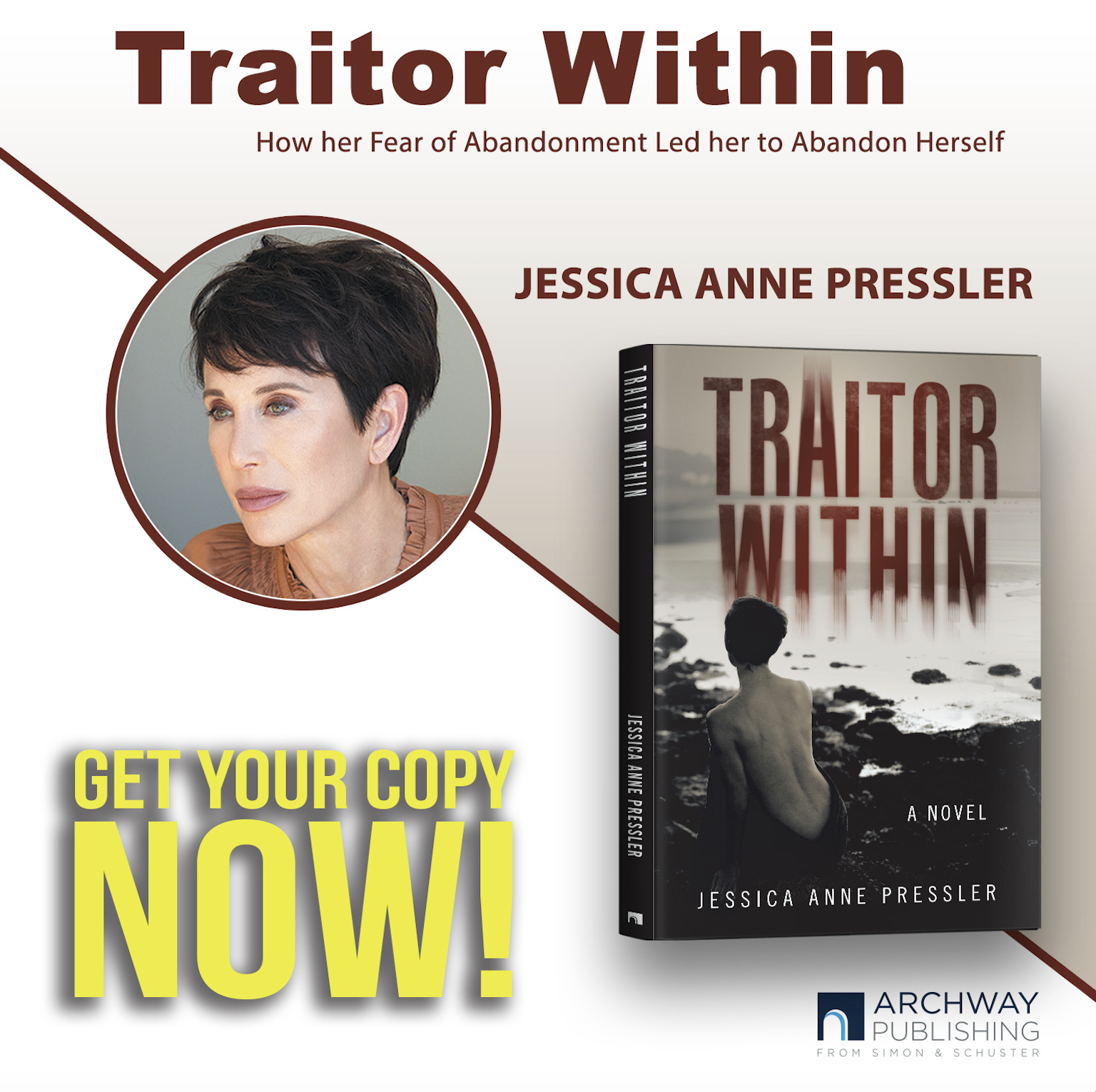
Continue the Journey with Traitor Within
If this article resonated with you, I invite you to explore these themes further in my novel, Traitor Within: How Her Fear of Abandonment Led Her to Abandon Herself.
Through Cassandra's story, I explore how childhood trauma, fear of abandonment, and learned survival patterns can follow us into adulthood, influencing our relationships, our choices, and the way we see ourselves.
My hope is that readers will recognize pieces of their own experiences within these pages and discover that it's never too late to break unhealthy patterns, reclaim your voice, and begin healing.
Ready to start reading?
Traitor Within is available in paperback, hardcover, and eBook formats.
Purchase on Amazon | Purchase on Barnes & Noble | Read on Apple Books
With love,
Jessica Anne Pressler, LCSW
Psychotherapist & Author of Traitor Within